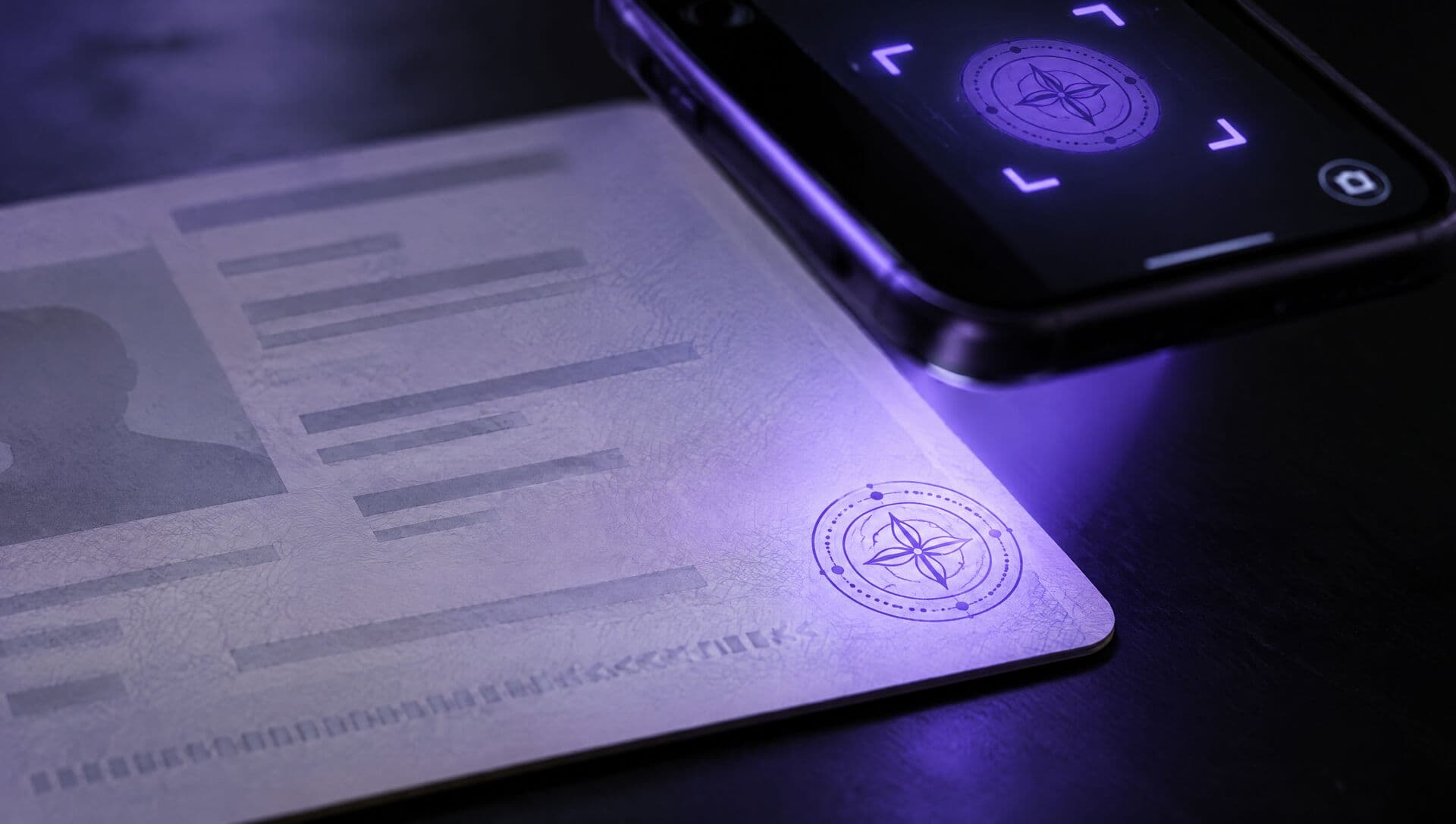
A printed mark that opens the record, for the right person.
The document stays in the registry. Its fifteen characters are printed as a scan mark on the paper. A phone reads the mark and, with the grant, its secure element and the owner's passkey, regenerates the document.
Healthcare, Financial services
Paper that points, rather than paper that holds.
Deeds, records, certificates and IDs are copied, posted and lost. Here the paper carries a pointer, not the document. Copying the paper copies a pointer that opens nothing on its own.
- For
- Registries, healthcare, banks, and issuers of certificates and IDs
- What travels
- Paper with a scan mark, about 90 bits
- What stays put
- The document, in the registry
- Products
- Digital Stamp, Implexus Vault, Safe
When the paper stops being the copy
- The paper is the document: lose it and it is gone.
- A photocopy passes for the original.
- No record of who opened what, or when.
- The paper points; the registry keeps the document.
- A photocopy points too, and opens nothing on its own.
- Every opening is logged; a withdrawn grant opens nothing.
Watch a deed go from the registry to a phone.
The mark's design, the four steps, then the record pinned to the paper in augmented reality. Scroll inside the demo or press Play; turn on CC for the narration.
- 01Implosion
The document is fingerprinted and folded into one root, named by fifteen characters.
- 02Transmission
Only the fifteen characters are printed, as a scan mark on the paper copy.
- 03Regeneration
Five checks: the mark, the cell, the grant, the phone's secure element and the owner's passkey or face. The document is rebuilt on the phone, bit-exact, and pinned to the page.
Demo with illustrative documents and values. Element counts and capacity per design are to confirm.

A title deed, checked at the counter.
- 01First
The registry implodes the deed and prints its mark on the owner's copy.
- 02Then
At the bank, the owner scans the mark with their phone.
- 03Finally
The grant, the phone and the owner's passkey are checked. The deed opens, and the opening is logged.
Example scenario, not a customer deployment.
What holds, every time
The mark names the document. It opens nothing by itself.
The mark, the cell, the grant, the phone's secure element and the owner's passkey or face.
The registry can withdraw a grant at any time; the same mark then opens nothing.
 Implexus Vault
 Safe
Questions about scan and retrieve
Draft answers. To confirm with product and engineering.
What if someone photographs the mark?
They have a pointer. Opening still needs the cell, a grant, a phone with the right secure element and the owner's passkey.
Does the mark need special printing?
[Print requirements: to confirm with the AR engine's design rules.]
Can the record change after printing?
[Versioning of the document behind a printed mark: to confirm with product.]
Put a mark on your documents.
Digital Stamp, on the engine, under a product licence.